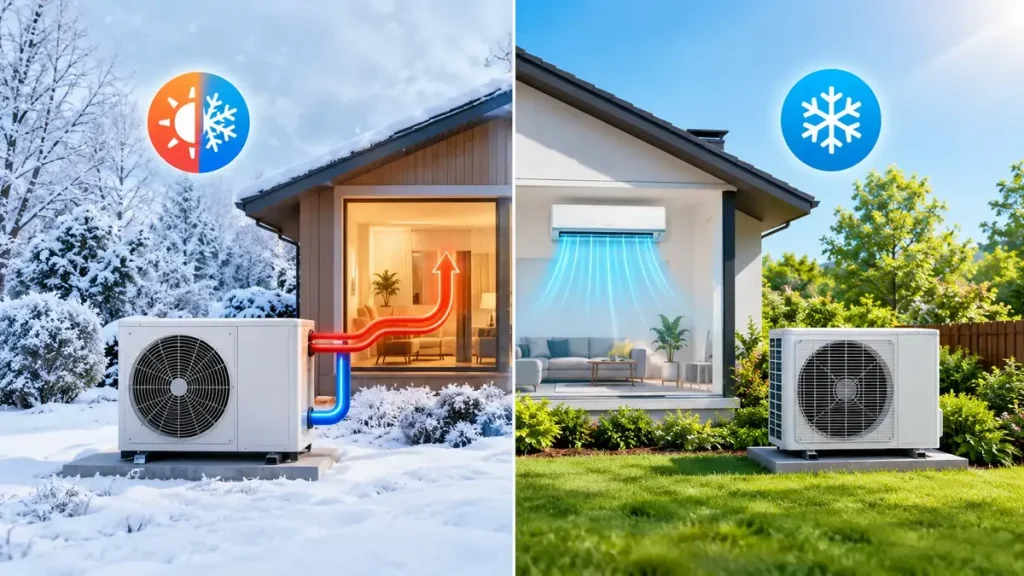
The choice between a heat pump and an air conditioner depends on your home’s heating and cooling needs, your budget, and your long-term energy goals. If you mainly want to keep your home cool in summer and already have a reliable heating system, an air conditioner is a more affordable option. However, a heat pump can provide both heating in the winter and cooling in the summer, making it a versatile choice for year-round comfort.
Although heat pump installation costs are generally higher, they can be a worthwhile investment because they’re energy-efficient and can reduce heating bills. In the UK, eligible homeowners can also use government grants to install air-source heat pumps.
Understanding the differences in efficiency, installation costs, and operating expenses will help you decide what’s right for you. This guide compares both systems so that you can choose the best option for your home.
Heat Pump vs Air Conditioner: Quick Comparison
| Feature | Air Conditioner | Heat Pump |
| Main job | Cooling only | Heating and cooling |
| Heats your home in winter | No – needs a separate heater | Yes |
| Supplies hot water | No | Yes (air-to-water systems) |
| Efficiency | Good at cooling; uses more power to heat | Very high – around 300%–400% (SCOP 3.5+) |
| Upfront cost | Lower (unit ~£620–£890 + ~£1,750–£3,000 to fit) | Higher (air-to-air ~£2,000–£4,000; air-to-water more) |
| Running cost – summer cooling | Similar to a heat pump | Similar to an air conditioner |
| Running cost – winter heating | Not applicable | Lower; can replace a gas boiler |
| Government grant | Not eligible | Up to £7,500 (Boiler Upgrade Scheme) |
| Works in cold UK winters | Cooling only | Yes, down to around −10°C |
| Best for | Summer cooling where heating already exists | Year-round comfort from one system |
What Is an Air Conditioner?
An air conditioner’s primary function is to keep your home cool. It draws warm air out of a room and removes the heat, leaving cool air behind. Professional air conditioning installation helps ensure the system is sized and positioned correctly to deliver effective cooling and comfortable indoor temperatures.
However, providing cooling is not its only function. An air conditioner also removes moisture from the air, a fact many people overlook. When humidity is low, sweat evaporates more easily, so you feel cooler even before the temperature drops. This is why a humid room feels more uncomfortable than a dry one, even when the thermostat is set to the same temperature.
Many air conditioners also purify the air. As air passes through the system, its filter traps dust, pollen, and other airborne particles. This purified air is especially beneficial for people with allergies. In short, an air conditioner performs three functions at once: it cools the air, removes moisture, and purifies it.
What Is a Heat Pump?
A heat pump transfers heat rather than generating it by burning fuel. During winter, it extracts heat from the outside air and transfers it indoors. In summer, a reversible heat pump can remove heat from inside to cool your home.
There are two main types:
- Air-to-air heat pumps: Transfer heat directly into rooms through indoor units. They provide space heating and cooling but usually don’t supply domestic hot water.
- Air-to-water heat pumps: Transfer heat into water for radiators, underfloor heating, and domestic hot water when connected to a suitable hot-water system.
Air-to-water systems are particularly relevant to UK homeowners looking to replace a traditional gas boiler. The best option depends on your property’s heating requirements, existing system, and available installation space.
The Main Difference: One Job or Two?
Once you understand these two types of units, the main difference between them becomes clear. An air conditioner provides only cooling. It excels at this function, but when winter arrives and you need heating, the air conditioner sits idle.
On the other hand, a heat pump functions in both ways. It adapts to changing seasons, keeping your home warm in winter and cool in summer. In short, instead of running two separate machines, you get both functions through a single system.
For this reason, your choice often depends on your current situation. If your home already has an adequate heating system and you only need relief from the summer heat, then an air conditioner is the right choice. However, if you need a single system for both heating and cooling, a heat pump is the best option. A heat pump installation ensures the system is sized and configured to meet your home’s heating and cooling needs. Because specifications such as noise levels and warranty periods vary by model, check the details carefully before you buy.
How Efficient Is Each One?
Heat pumps are known for their efficiency. For every unit of electricity consumed, a heat pump provides approximately three to four units of heat. Instead of generating heat itself, it transfers heat from one location to another; as a result, it delivers significantly more heat than the energy it consumes.
This is often described as 300% to 400% efficiency. Conventional heaters cannot compete, as they can never produce more energy than they consume. Many modern heat pumps feature an efficiency score known as an SCOP rating, often exceeding 3.5, confirming this level of performance.
While air conditioners cool efficiently, they use more electricity when used for heating. So, if heating is a primary requirement, a heat pump can deliver greater year-round cost savings.
What Do They Cost to Buy and Run?
Money is often a deciding factor, so let’s look at the actual figures. Installing air conditioning is relatively affordable. A wall-mounted unit costs approximately £620 to £890, with total installation costs ranging from about £1,750 to £3,000. A simple portable unit costs even less and requires no installation.
The initial investment for a heat pump is higher. An air-to-air system typically costs between £2,000 and £4,000, while an air-to-water system, which involves more extensive work and additional components, costs more, including installation.
The running costs for summer cooling are surprisingly similar. However, winter costs differ significantly. An air conditioner cannot heat your home, so you would still have to run separate heating equipment. A heat pump handles both functions and can even replace a gas boiler, potentially reducing your long-term bills. For many households, the higher upfront cost pays for itself over time.
Can You Get a Grant to Help?
For some people, the initial cost of a heat pump can be quite high, but help is available. In England and Wales, the government operates the Boiler Upgrade Scheme, which offers a grant of up to £7,500 for air-source heat pumps. This covers a significant portion of the total cost.
Air conditioners aren’t eligible, as the scheme is designed to promote greener, low-carbon heating. Therefore, if you are comparing the two based solely on price, keep in mind that the grant can cover most of the cost difference. The team at Prime Time Boilers can explain whether or not your home qualifies.
Which One Is Right for You?
The best choice depends on your home and your goals. If you already have a reliable heating system, live in a smaller space like a flat, and primarily want to stay cool during warmer periods, choose an air conditioner. It is affordable to install and performs its specific function very well.
If you want year-round comfort from a single system, want to reduce your carbon footprint, and prefer lower running costs over time, choose a heat pump. This option suits homes with some outdoor space and good insulation.
If you are still unsure, ask an expert to assess your home. A free survey from Prime Time Boilers removes the guesswork and ensures you get the right system for your needs.
Conclusion
Heat pumps and air conditioners might seem like rivals, but they serve different needs. Air conditioners are designed specifically for cooling, offering an affordable way to beat the summer heat. On the other hand, a heat pump is a versatile, all-rounder appliance that provides both heating and cooling; it operates very efficiently and can even help you secure a grant of up to £7,500.
Consider your budget, existing heating system, and the indoor environment you want to maintain year-round. Whether you live in Essex, Chelmsford, Colchester, Romford, Hertfordshire, or Basildon, the right choice depends on your property’s heating needs, insulation, and available space. Prime Time Boilers can help you assess your home, compare suitable heating and cooling options, and choose a system that meets your needs. Once you have clarity on these points, choosing the right option becomes much simpler.
Frequently Asked Questions
Can a heat pump cool my home just like an air conditioner?
Yes, many heat pumps can reverse their flow to cool your rooms during the summer, much like an air conditioner. Not every model does, so if cooling is important to you, check the specifications before you buy.
Is an air conditioner cheaper than a heat pump?
Generally, purchasing and installing an air conditioner costs less. While a heat pump costs more upfront, it provides both heating and cooling, can potentially replace your boiler, and may also qualify for grants. This often makes it a better value over time.
Do heat pumps work when it is really cold outside?
Yes. The fluid inside a heat pump boils at about minus 50 degrees, so it can extract heat even when the outside temperature is minus 10 degrees. A properly sized system can keep a UK home warm throughout the winter.
Can a single system provide both heating and cooling?
A heat pump can. It warms your home in winter and cools it in summer, all from a single unit. An air conditioner provides only cooling, so you will need a separate heating system for the colder months.
Which option is better for the environment?
A heat pump is the greener option. Instead of burning fuel, it transfers existing heat, so it uses less energy and produces fewer emissions. That’s why it qualifies for government assistance, while air conditioning does not.