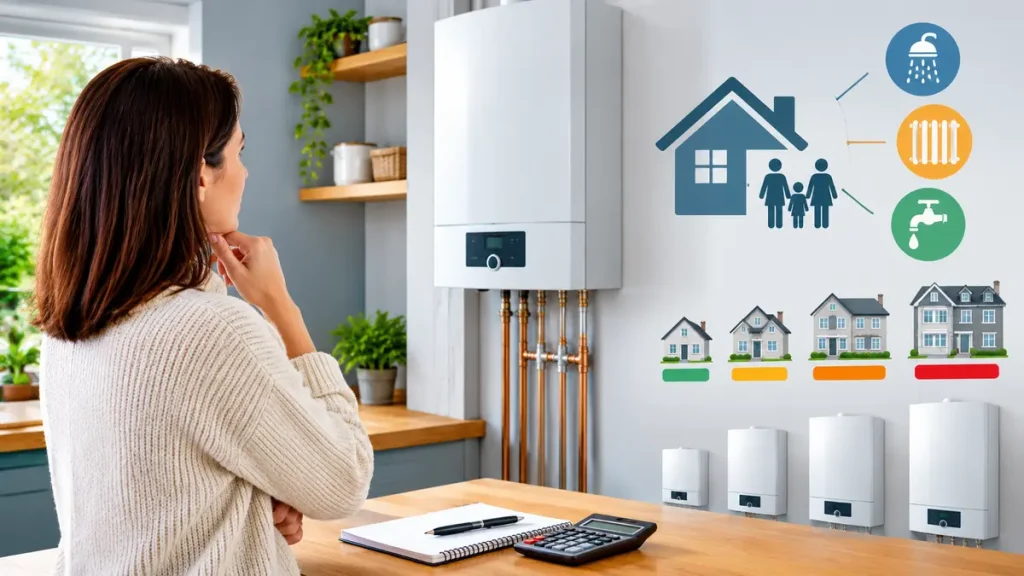
Selecting the right-sized boiler is crucial for keeping your home warm, ensuring a reliable hot water supply, and keeping energy bills under control. But what size boiler does your home need? The answer depends on several factors, including your home’s size, the number of radiators and bathrooms, your hot water usage, and the quality of your home’s insulation. A boiler that is too small may struggle to heat your rooms effectively, while an oversized boiler can waste energy by cycling on and off too often. In most cases, a three-bedroom home may need a boiler with a capacity between 28kW and 35kW, though specific requirements can vary.
This guide covers boiler sizes, boiler types, heating needs, and hot water flow rates to help you choose the right boiler for your home.
What Does “Boiler Size” Actually Mean?
The first surprising point here is this: the ‘size’ of a boiler has nothing to do with the physical dimensions of the unit mounted on your wall. When heating experts talk about “size,” they mean its capacity or power, how much heat the boiler can generate. This power is measured in kilowatts (kW).
Think of kW as your boiler’s “muscle.” The higher the figure, the more heat the boiler can supply to your radiators and the more hot water it can deliver to your taps at the same time. A lower figure indicates lower capacity. Therefore, two boilers that look identical from the outside can have vastly different power levels.
In most homes, this power rating affects both central heating and the hot water supply. However, large homes that need significant amounts of hot water at once must also consider another factor: “flow rate”, which we will discuss shortly. Choosing the right capacity is also key to professional boiler installation, as it helps ensure the system meets your home’s heating and hot water needs. For now, remember one rule: size means power, not the unit’s physical dimensions.
The Three Main Boiler Types
Before you choose a size, you need to know what type of boiler you have, because the required output depends on it.
- A combi boiler heats water on demand when you turn on a tap and doesn’t use a separate tank or cylinder. These units are compact and well-suited for smaller homes with a single bathroom. However, because they provide hot water instantly, they generally require a higher kW output relative to their size.
- A system boiler works with a hot water cylinder, but it doesn’t require a loft tank. The cylinder stores hot water, so you can use multiple taps or showers at the same time, making it ideal for larger households with higher hot water demand.
- A regular boiler, also known as a conventional boiler, typically utilizes both a hot water cylinder and a cold water tank. This setup is common in older homes. Once you have identified your boiler type, you can determine the appropriate output capacity.
Boiler Size by House Size
Before booking a survey, it helps to estimate what most homes typically require. The table below is a rough guide; factors such as insulation, the number of bathrooms, and your home’s construction method can influence these figures.
| Property size | Typical radiators | Combi boiler | System / regular boiler |
| 1–2 bed flat or small house | Up to 10 | 24–27kW | 9–18kW |
| 3 bed house | 10–15 | 28–34kW | 18–26kW |
| 4 bed house | 15–20 | 32–40kW | 24–30kW |
| 5+ bed house, 2+ bathrooms | 20+ | 35–42kW | 30–40kW |
Combi boilers generally require a higher output because they heat water only when needed; in contrast, system and regular boilers can operate at a lower output because they use a cylinder to store hot water. If you live in a mid-terrace house or frequently use large amounts of hot water at the same time, consider a higher-capacity boiler, and consult an expert to confirm it’s the right choice.
How to Estimate Your Boiler Size at Home
You cannot determine an exact figure without professional help, but you can make a reasonable estimate by looking at your radiators. The larger the radiator, the more heat and energy it requires.
| Radiator size | Typical use | Heat output |
| Small | Cloakroom, small bathroom, box room | Around 1.5kW |
| Medium | Average bedroom, kitchen, dining room | Around 2kW |
| Large | Living room, large bedroom, open-plan space | Up to 3kW |
To determine your estimated requirement:
- Count your radiators and divide them into three groups: small, medium, and large.
- Multiply the number of radiators in each group by their respective kW rating, then add these figures together to find your total heating requirement.
- Add about 3–4 kW for hot water to cover a typical household’s needs.
For example, a home with 2 small (3 kW), 5 medium (10 kW), and 3 large (9 kW) radiators requires 22 kW for heating. Adding 3 kW for hot water brings the total requirement to approximately 25 kW. This calculation doesn’t account for insulation or the house layout, so treat it as an estimate rather than an exact figure.
Flow Rate: Don’t Overlook It
If you are considering a combi boiler, the flow rate is an often-overlooked factor. The kW rating indicates how hot the water gets, while the flow rate tells you how much hot water you receive per minute.
For example, a 24kW combi boiler delivers approximately 10 litres of hot water per minute, enough for a single shower. However, if you run two showers at once, the flow splits between them, resulting in poor, disappointing performance. A small combi boiler will struggle when multiple outlets are used at once, no matter how modern it is.
If this sounds like your household, choose a high-output combi boiler or a system boiler paired with a cylinder to store more water. By considering how your family actually uses water rather than simply counting the number of rooms, you can avoid many morning hassles.
How Insulation Can Reduce the Size You Need
Here is a tip that can genuinely save you money. The better your home retains heat, the less power your boiler will require. Loft and cavity-wall insulation, double glazing, and simple draught-proofing all help reduce heat loss from your home.
In larger properties, the impact is greater than you might expect. A poorly insulated house with five bedrooms and two bathrooms might need a 40kW boiler; improve the insulation, and the same house could run on a 30kW unit. This translates to a smaller, more affordable boiler and lower energy bills. So before opting for a larger unit to warm a cold home, check your insulation and seal gaps first; it’s usually cheaper than heating air that simply escapes.
The Most Accurate Method: A Heat Loss Survey
The radiator method gives you a guide, but a heat loss survey is the only way to get an accurate figure, and it’s the approach UK building regulations point to. The logic is simple: your boiler only needs to replace the heat your home loses, so the real question is how fast it loses it.
A qualified engineer assesses the property room by room, including walls, windows, floors, and insulation, to determine how much heat escapes on the coldest day of the year. The result is tailored to your home, not guessed from the number of bedrooms. Two identical-looking houses can lose heat at very different rates, something no online calculator can detect. Prime Time Boilers includes this assessment in their free boiler survey, so you get a boiler matched to your home.
Signs Your Current Boiler Is the Wrong Size
If you already have a boiler, your home may be telling you it’s the wrong size. Watch for:
- Rooms that never warm up, no matter how long the heating runs.
- Hot water that runs out, leaving the last person with a cold shower.
- A boiler that constantly switches on and off (short cycling).
- Energy bills are creeping up for no obvious reason.
- Uneven heat, with some rooms warm and others cold.
Frequent cycling usually points to an oversized boiler, while poor heating and weak hot water suggest it’s undersized. A replacement is a good chance to put this right for the next decade.
Conclusion
The key thing to remember is that boiler size is measured in kilowatts, not physical dimensions, and the right figure keeps you warm, trims your bills, and extends the boiler’s life. Start by choosing the right type, estimate from your radiators and hot water habits, then check your insulation, since better heat retention may let you drop to a smaller unit. For a precise answer, book a professional heat loss survey. Whether you’re in Essex, Chelmsford, Colchester, Romford, Hertfordshire or Basildon, a Gas Safe-registered installer like Prime Time Boilers can turn an estimate into a clear, confident choice.
Frequently Asked Questions
1. What size boiler do I need for a three-bedroom house?
Most three-bedroom homes need a boiler between 28kW and 35kW, depending on the number of bathrooms, radiators, and how well the house retains heat. A well-insulated home will fall at the lower end of this range, while an older, draftier house will require higher capacity. Consider this a starting point, and have a professional survey conducted to confirm your specific requirements.
2. Is it better to get a larger boiler just to be on the safe side?
No. An overly powerful boiler will frequently switch on and off (“short-cycling”), wasting fuel and causing premature wear; as a result, it will cost more in the long run. The best choice aligns with your home’s actual heating and hot water needs.
3. Should my new boiler be the same size as my old one?
Not necessarily. Older boilers were often oversized, while a modern A-rated model can deliver the same performance at lower power output. If you have added insulation, replaced radiators, or extended your home, it is worth re-evaluating the required size.
4. Can I determine the correct size myself?
You can estimate this by calculating your radiator requirements and considering your hot water usage. To get an accurate figure, however, you need a professional to calculate heat loss, a process that accounts for factors such as insulation, windows, and the building’s structure.
5. What happens if my boiler is too small?
An undersized boiler struggles to heat every room and may run out of hot water during peak times. It often runs continuously, which increases utility bills and causes the unit to wear out prematurely.