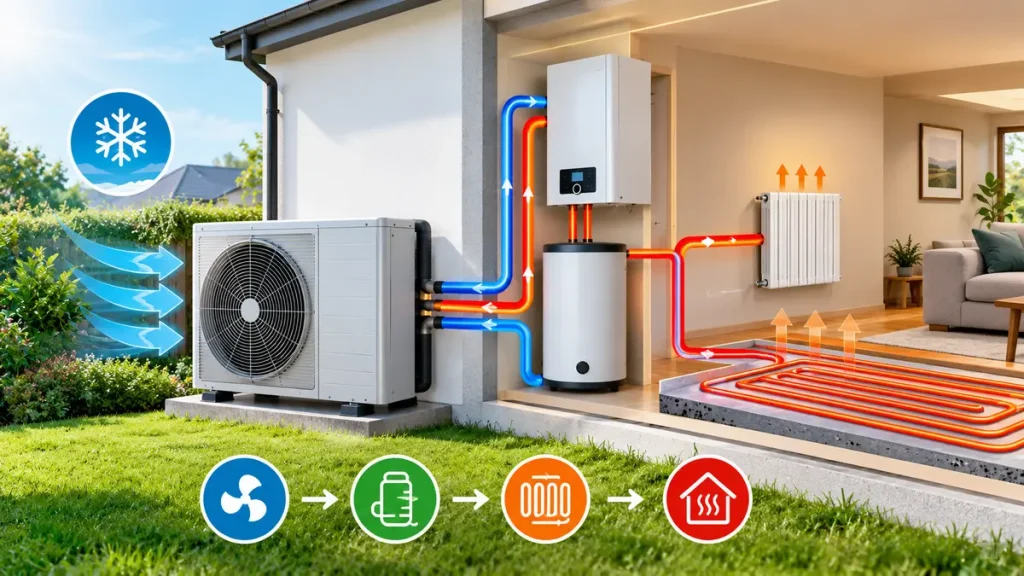
An air source heat pump is an energy-efficient heating system that extracts heat from the outside air and transfers it into your home, even during cold British winters. Instead of burning gas or oil, it uses electricity to move heat, helping you maintain a comfortable indoor temperature while potentially reducing your energy bills and carbon emissions. But how does an air source heat pump work, and is it right for your home? The process involves a refrigerant that absorbs heat from the outside air, a compressor that raises its temperature, and a heat exchanger that transfers the heat into your home’s heating system. Depending on the type, a heat pump can heat your rooms, provide hot water, and sometimes even cool your home in summer.
In this guide, you will learn how heat pumps work, their main types, winter performance, efficiency, benefits, and practical tips for getting the best results.
What Is an Air Source Heat Pump?
An air source heat pump is a low-carbon heating system that moves heat rather than making it. It draws warmth from the outside air and transfers it indoors to heat your rooms and hot water, using only electricity. Some models can also run in reverse during summer, removing heat from inside to cool your home.
The easiest way to picture it is a fridge working in reverse. Heat is energy, and it always flows from warmer to cooler, which is why a hot drink cools to room temperature. A fridge uses this principle to pull heat out of its interior and release it at the back. A heat pump does the opposite; it extracts heat from the cold outdoor air and brings it inside. The science is the same; only the direction changes. Because even cold air still holds usable energy, a good unit keeps working at temperatures well below freezing.
How an Air Source Heat Pump Works, Step by Step
The system runs on a continuous loop using a fluid called a refrigerant, which boils at a very low temperature and reacts quickly to small changes in heat. One full cycle looks like this:
- Air intake: A fan draws outside air across the unit and over the evaporator.
- Evaporation: The refrigerant absorbs heat from the air and boils, turning from a liquid into a gas.
- Compression: A compressor squeezes the gas, sharply raising its temperature, much like a bicycle pump warming up as you use it.
- Heat exchange: The hot gas passes through a heat exchanger, giving up heat to the water in your central heating system, then cools back into a liquid.
- Distribution: The heated water flows through your pipes to radiators, underfloor heating and hot water taps.
- Repeat: The cooled refrigerant returns to the start and the cycle begins again.
It is a sealed, closed system. Nothing is burned, and the same refrigerant is reused repeatedly, which is a major reason the system is so efficient.
The Two Main Types: Air-to-Air and Air-to-Water
Not all heat pumps deliver warmth the same way, and the right choice depends on your home.
- An air-to-air heat pump moves heat between the outside air and the air inside your home, blowing warm air into rooms through indoor units. Many models reverse in summer to provide cooling. The drawback is that it cannot heat water for taps and showers, so you still need a separate hot water system.
- An air-to-water heat pump transfers heat from the air into water, which then circulates through radiators or underfloor heating and fills a hot water cylinder for taps, showers and baths. It works especially well with underfloor heating and larger, low-temperature radiators, which makes it the most common choice for whole-home heating in the UK.
| Feature | Air-to-Air | Air-to-Water |
| How it delivers heat | Warm air through fans and coils | Heated water through radiators and underfloor pipes |
| Heats hot water (taps/showers) | No – needs a separate system | Yes – fills a hot water cylinder |
| Summer cooling | Yes | Usually no (some models offer it) |
| Works with underfloor heating | Not applicable | Excellent |
| Installation | Cheaper and simpler | Slightly more involved |
| Best suited to | Smaller spaces and homes wanting cooling | Whole-home heating and hot water in one system |
Does It Really Work in Winter?
This is the question almost everyone asks, and the answer is yes. Early models did struggle in the cold, but modern units handle British winters well. The key improvement is the compressor, which now adjusts its speed to match the weather, working harder as temperatures fall and easing off as they rise. This lets the system keep pulling heat from the air even below freezing.
On very cold days, a thin layer of frost can form on the outdoor unit. The heat pump detects this and runs a short automatic defrost cycle to clear it. You may notice a brief dip in temperature while it does so, which is completely normal and requires no action from you. Keeping around 60cm of clear space around the unit and clearing away leaves or snow helps it run smoothly through the coldest months.
Why Heat Pumps Are So Efficient
Heat pumps stand out for their efficiency. A good unit can reach over 350% efficiency, while an A-rated gas boiler runs at around 90%. That figure sounds impossible until you remember that a heat pump does not create heat by burning fuel. It simply moves heat that is already in the air, so for every unit of electricity it uses, it can deliver three to four units of heat.
This efficiency isn’t new; the principle behind the heat pump dates back to Lord Kelvin in 1852, but rising energy costs and the shift toward cleaner heating have made it a mainstream option only in recent years. An annual heat pump service keeps the refrigerant, filters, and electrical parts in good order, so the system maintains its efficiency over time.
The Benefits of an Air Source Heat Pump
Beyond the heat itself, a heat pump brings several advantages:
- High efficiency, using far less energy than a gas or oil boiler to warm the same home.
- Lower carbon emissions, with heating-related emissions cut by around 80% compared with a gas boiler, a figure that improves as the grid gets greener.
- Reliable, even comfort, giving gentle, steady warmth rather than short blasts of heat.
- A long lifespan, typically 15 to 20 years, longer than many boilers.
- Cleaner indoor air, since no gas is burned inside the home.
- Added property value, which many homeowners see as a long-term gain.
Getting the Most From Your Heat Pump
A heat pump only performs as well as the home around it, so a few things make a real difference to your savings:
- Insulate first: Heat pumps provide gentle, continuous heat, so warmth lost through poorly insulated walls, lofts, or windows is wasted money. Sorting insulation out first means every unit of heat counts.
- Size your radiators correctly: Because the system runs at lower temperatures, it works best with larger radiators or underfloor heating.
- Consider what you are replacing: Savings are greatest when you switch from an older, expensive system, such as electric or oil heating.
Getting these fundamentals right is the difference between a system that merely works and one that genuinely lowers your bills. The team at Prime Time Boilers can carry out a full home survey to assess insulation, radiators and pipework before any installation.
Conclusion
An air source heat pump is a simple idea that delivers impressive results. It takes free heat from the outside air, lifts it with a small amount of electricity, and spreads it through your home for heating and hot water all without burning a drop of fuel. Modern units handle British winters easily, run far more efficiently than a gas boiler, and cut your carbon footprint.
If your home is well-insulated and fitted with suitable radiators, an air source heat pump can be a comfortable, future-proof solution to keep your home warm for years to come. Whether you live in Essex, Chelmsford, Colchester, Romford, Hertfordshire, or Basildon, the best next step is to arrange a professional home assessment. The team at Prime Time Boilers can inspect your property, assess your heating needs, and help you decide whether an air source heat pump is right for your home.
Frequently Asked Questions
1. Can an air source heat pump work with my existing radiators?
Often, yes, as long as they give out enough heat at lower flow temperatures. Larger radiators usually work well, while smaller ones may need checking or upgrading.
2. How long does an air source heat pump last?
A well-installed, regularly serviced unit typically lasts 15 to 20 years. With fewer moving parts and no fuel combustion, they wear out less than traditional boilers.
3. Do heat pumps make noise?
Modern units are quiet. Installed correctly, they produce only a soft hum. A sudden loud noise means something needs checking.
4. How much maintenance does a heat pump need?
Very little, usually one service a year to check the refrigerant, filters, and electrical system. Between visits, keep the outdoor unit clear of leaves, snow, and debris.
5. Can a heat pump both heat and cool my home?
Air-to-air models can switch between heating and cooling. Air-to-water systems mainly provide heating and hot water, though some also offer cooling.